Sunday, April 23, 2017

Youtube daily report w Apr 23 2017

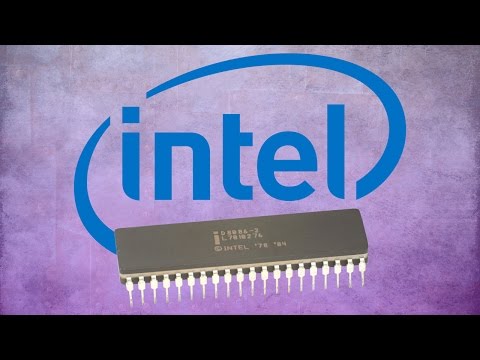
At the heart of your phone, tablet and computer lies the microprocessor, a tiny chip home

to billions of transistors capable of processing an immense amount of information.

Without the microprocessor, modern technology could not exist, which is why this week we'll

be looking at the company that started it all, Intel.

December 23, 1947.

After two years of restless labor at Bell Laboratories, these three men stood in awe

of the transistor, their greatest invention.

The man in the middle was William Shockley, an entrepreneurial fellow who realized what

a fortune he could make from this new technology.

In 1956 he moved to the west coast, establishing the first silicon device company in what came

to be known as Silicon Valley.

He couldn't convince any of his former colleagues at Bell Labs to leave with him and so he resorted

to hiring fresh university graduates.

In an ironic twist of fate, just one year later eight of his brightest employees got

together and left the company in the same way that he had left Bell Laboratories.

Under the patronage of industrialist Sherman Fairchild, the "Traitorous Eight", as

they were called, founded Fairchild Semiconductor.

Much to Shockley's dismay, Fairchild became one of the leaders of the industry while his

own venture failed.

In 1959 one of the original "Traitorous Eight", Robert Noyce, created the first

integrated circuit.

Like the transistor before, the integrated circuit was a technology with huge potential,

and he knew that.

In 1968 he left Fairchild to start his own company and he was joined by his colleague

and fellow 'traitor' Gordon Moore, who had famously postulated Moore's law.

To fund their venture they went to Arthur Rock, the acclaimed investor who had arranged

their original deal with Sherman Fairchild a decade earlier.

With $3 million of initial capital and the creative portmanteau of integrated electronics,

Noyce and Moore founded Intel on July 18, 1968.

Behind their venture was the ambitious plan to build large-scale integrated semiconductor

memories.

Back then, they were ten times more expensive than standard magnetic core memories, which

were much slower and less efficient.

Nine months after its creation, Intel had developed its first product: the 3101 Schottky

bipolar memory.

It was the world's first solid state memory device and it was capable of storing a whopping

64 bits.

One year later, Intel became pioneers in dynamic random access memory, or DRAM, by creating

the first commercially available DRAM chip, the 1103.

Its success marked the beginning of the end for magnetic memory and established DRAM as

the primary storage medium of modern computers.

Intel's reputation grew quickly, and not just in the United States.

A Japanese calculator company called Busicom had reached out to Intel in 1969 with a request

to build integrated circuits for their calculators.

While working on this project, Intel engineer Ted Hoff figured out a way to build a central

processing unit onto a single chip.

By cramming 2,300 transistors onto a one-eighth- by one-sixth-inch chip, Hoff's invention

had the same power as the ENIAC computer that was the size of a room.

Intel had unwittingly stumbled upon the foundation of modern computing, the microprocessor.

They called it the 4004 and started selling it in 1971.

A year later, Intel unveiled the 8008, an 8-bit microprocessor.

Intel's first general-purpose microprocessor, the 8080, came in 1974 and it essentially

became the industry standard, finding its way into almost every cash register, calculator

and traffic light of its day.

Interestingly enough, the 8080 was designed for almost everything except computers.

At the time, computers were manufactured entirely in-house, with a single company building its

own terminals, compilers, and operating systems.

The 8080, however, became so popular that the manufacturers, starting with Hewlett Packard,

eventually began designing their systems around it.

In 1978 Intel released the 8086, a 16-bit processor that would eventually become Intel's

saving grace.

Up until that point Intel's revenues were coming almost entirely from their DRAM division,

but Japan's rising semiconductor industry was quickly eating away at their profits.

Intel's only way forward was microprocessors, and they went all in by partnering up with

IBM.

We've already covered IBM in a previous video, but just to recap, in the early 1980s

IBM were struggling to catch up with the rise of the personal computer.

At first, IBM didn't think PCs would be worth it to the average person, but once that

started happening anyway, IBM's bureaucracy made developing their own PC a nightmare.

They ended up partnering with Intel for their processor and with Microsoft for their operating

system, which allowed them to develop their IBM PC in just under a year.

It was released in 1981 and it became the dominant personal computer of its time, establishing

Intel as the chief supplier of processors.

The IBM PC used a modified 8086 processor, and although IBM eventually lost the personal

computer market to cheap compatible copycats, Intel remained at the heart of every personal

computer made over the next decade.

The legacy of the 8086 remains to this day, as the vast majority of modern computers are

based on its derivative x86 architecture.

During the 1980s Intel emerged as the most profitable hardware supplier to the rising

PC industry.

They reached $1 billion of revenue in 1983, and the same amount as net income just nine

years later.

In 1993 Intel released the Pentium line, their fifth generation of processors.

For this generation Intel started building dedicated motherboards alongside its processors,

a move that kept them ahead of their competition and doubled their net income that year to

$2.3 billion.

Throughout the 90s Intel continued to develop more powerful processors, more or less in

accordance with Moore's law.

In 1998 Intel branched out into the value-PC market by releasing the cheap, low-performance

Celeron line.

The new millennium, however, would be a much more difficult time for Intel.

The dot-com crash and fierce competition from AMD saw Intel fall below 80% market share

for the first time in decades.

The situation became so bad that in 2001 Intel's profits had slumped by a stunning 87%.

By that point it became clear that racing to build faster and faster processors wasn't

the way to go, especially when most people were using their computers just to read their

email or browse the web.

Intel shifted their focus accordingly, building a more efficient, less power-hungry line called

Centrino.

Released in 2003, the Centrino wasn't actually a processor but a fully functional platform,

complete with a chipset and wireless network.

It worked extremely well on portable computers just around the time when laptops were finally

starting to take off, lifting Intel back to the top of the industry.

In line with their new philosophy, Intel began developing multi-core processors, releasing

their first dual-core in 2005.

In general, the past few generations have been split into three main categories based

on processing power: i3, i5, and i7.

Up until last year, Intel were operating on a "Tick-Tock" model, where they either

shrink the size of the current microarchitecture to make it more efficient or release an entirely

new one every 18 months.

The performance of the last two generations hasn't improved that much though, and Intel

have also attracted a lot of antitrust litigation.

In 2009 the European Union fined Intel more than one and a half billion dollars for bribing

computer manufacturers to use their processors.

Similar accusations have sprung up in the US, Japan and South Korea.

Despite the lawsuits, Intel's business has been going great, and they've been able

to branch out into various other tech markets, usually through acquisitions.

Among other things they're working on solid-state drives, machine learning and autonomous vehicles.

Some of these projects are more successful than others, but it's unlikely that they'll

be replacing Intel's main microprocessor business any time soon.

Thanks for watching and a big thank you to all of our patrons for supporting this video!

Be sure to subscribe if you haven't already and to check out the full Behind the Business

playlist for the interesting stories of other companies.

One again, thanks a lot for watching, and as always: stay smart.

For more infomation >> Intel: The Godfather of Modern Computers - Duration: 9:05.

-------------------------------------------

Грибы - Тает Лёд - Duration: 3:11.

✔ Subscribe Channel ♛

For more infomation >> Грибы - Тает Лёд - Duration: 3:11.

-------------------------------------------

What do we gain from home cooking? - Duration: 5:07.

Hello, welcome at this new vlog of Belicons.

Nice that you are watching.

This week my blog and vlog are about E numbers.

Many people dislike E numbers and there are even books written about what these numbers

stand for exactly and whether they are good for us or not.

To the amazement of many a microbiologist, Rosanne Hertzberger, published a book last

week in which she praises E numbers.

According to her they are good for us and she likes buying foods that contain E numbers.

Many people were angry about this and I think that many of them didn't really take a good

look at why she is of this opinion.

In my blog I did consider her arguments, although I still didn't agree with her.

But I kept thinking about one of her arguments.

And that is that because of E numbers we don't have to throw away so many foods and thus not waste it.

And she does have a point there of course.

E numbers are all kinds of additives, a better smell, a better colour, but also preservatives.

So some E numbers make sure that our foods don't spoil that quickly.

It is of course true that we throw away many foods each day.

One example is bread.

At the end of the day supermarkets, bakers, and other salesman of bread throw away all

the bread that people didn't buy.

And that is a real problem of course.

But the question then is whether preservatives are the best solution.

We sometimes tend to see only one solution for a problem and think: 'Well, just do

it, even when there are downsides to it.'

But I think that we have more possibilities to waste less food and that it is also important to do so.

For example that we no longer expect to be able to buy fresh foods at each moment of the day.

I myself do think that it's easy when I can still buy some bread after working hours.

But at the same time I also feel that it's a bit strange that just a half an hour before

closing time, I can still choose from several breads that will all be thrown away very soon.

If we would just accept that the supermarkets are out of fresh products at a certain moment,

then we should just make sure that we buy them sooner.

And in that way we don't have to waste that much.

And if we don't want this.

If we insist on being able to buy fresh product at any moment, then there is another solution.

In that case we can also make better plans about what to do with foods that cannot be

sold any more.

At this moment supermarkets are not allowed to give it away.

But that makes no sense of course.

This bread and other fresh products are fine the next day, just a bit older.

We should just consider how these foods can be given away to people who really need it

and at the same time make sure that these people won't get spoiled foods.

It's odd that we throw away many foods and at the same time there are people who are hungry.

And I think that this solution is even better than preservatives, for if food doesn't

spoil any more, supermarkets won't have foods left for the people who need it.

Maybe some people are wondering now why we would go through all this trouble.

If we can make sure that food doesn't spoil that easily any more because it contains preservatives,

well let's do that?

It's a lot easier.

And if they use the real names on the products instead of the numbers, we can make better

choices and thus this may not be a problem any more.

Well, this is partly true for not all E numbers are bad.

But at the same time I would regret it when it turns out that we are living in an era

in which everything needs to be done quickly, quickly, quickly, so that we feel that we

don't have enough time any more and thus we need to buy fresh products close to closing time.

Do we really want to live in a society like that?

It isn't true that we really don't have enough time, for we have a lot of time to

spend on Facebook and to watch Netflix, etc.

So that means that we can also take more time for other things, if we want that.

That is a choice.

And I'm not saying that we need to go back to the 1950s in which people needed to go

to the shop for hours and cook for hours.

We all have freezers, and we can preserve much more in that than many of us are thinking.

So we don't need to go to the supermarket each day to buy fresh foods.

But if we would just take just a bit more time for all of this, then we would also take

more time for each other and that will give us something that we cannot get from Facebook or Netflix.

And if we do that then we also learn more about what we like.

Try to experiment with herbs.

The more you practice with that, the better you know what you like and the less effort

it takes to make something tasty.

If you only buy ready-to-serve meals, you won't experience all that.

So next to all of the downsides there are to E numbers, I think that it is good to wonder

in what kind of society we would like to live.

A society in which we mainly eat ready-to-serve meals and everything needs to be done quickly, quickly, quickly.

In which we know less and less of foods and have less and less time for each other?

Or in a society in which we take a bit more time to shop, to cook and for each other?

These are my ideas.

Let me know what you think, on Belicons or on YouTube.

And don't forget to mention your arguments of course.

I'm really curious and I will see you next week.

Bye!

For more infomation >> What do we gain from home cooking? - Duration: 5:07.

-------------------------------------------

Não cometa esses erros com o seu dinheiro! Aprenda com os meus erros! Série Saindo do Buraco ep #8 - Duration: 5:31.

For more infomation >> Não cometa esses erros com o seu dinheiro! Aprenda com os meus erros! Série Saindo do Buraco ep #8 - Duration: 5:31.

-------------------------------------------

Drake Shoots Down Rumors of Model Pregnancy Claims and Threatens to Sue Her | JTNEWS - Duration: 2:04.

his jordans out with JT news will a

quick update on the whole Drake

pregnancy situation with this girl named

lace well they're saying that she kind

of fabricated this story on Instagram

this girl named lace claimed that she

was pregnant with Drake's baby and

Drake's not taking her phone calls

anymore drinks claiming he never even

met this girl okay they threatened to

sue this girl and she since to leave it

all the post he was posting up like

posts of her like pregnant you know like

the pregnancy test text message between

her and Drake supposedly and then even a

text between her and a DJ with the DJ

gave her number heard drake's number to

her and she texts Drake's this DJ had

since text turn be like damn you're

everywhere with the pregnancy were

Mississippi I'm trying to come up and

all this bullshit you know I'm trying to

get my money he's like what about when

they know find out it's not true and she

was like well are to be rich at that

point known it's like you know this

gives girls a bad name just things like

this okay now I they threatened to sue

where she took down the pit she also did

an interview with kay slay about this

okay so i'll put that below i'll link

the interview with kay slay below um

tell me what you guys think about it i

mean you know he's a target he's a rich

guy he's famous people can come up off

you with fame and all this other stuff

I've seen a half and a happened since

you know you just got it it's got to

play the game as part of the game right

but anyways what do you guys think do

you think she's still lying do you think

that Drake telling the truth what do you

guys think makes you come out of this

video tap to subscribe button specialist

here on your mobile phone I appreciate

you guys and I'll check you guys in the

next video sorry and I move around a lot

of my videos as you can see when I'm

expressing myself I jump around but

makes you hit a like button for me

appreciate you guys know checking on the

next video peace

For more infomation >> Drake Shoots Down Rumors of Model Pregnancy Claims and Threatens to Sue Her | JTNEWS - Duration: 2:04.

-------------------------------------------

Fahrenheit - parte 20: Back to Agatha - Duration: 4:05.

For more infomation >> Fahrenheit - parte 20: Back to Agatha - Duration: 4:05.

-------------------------------------------

Wat levert zelf koken ons op? - Duration: 4:58.

For more infomation >> Wat levert zelf koken ons op? - Duration: 4:58.

-------------------------------------------

Síntese & Projetonave - Não Mais Problemas (no Estúdio Showlivre) legendado - Duration: 4:11.

For more infomation >> Síntese & Projetonave - Não Mais Problemas (no Estúdio Showlivre) legendado - Duration: 4:11.

-------------------------------------------

MEETING IN THE AIRPORT | A Trip We Won't Forget (long distance relationship) - Duration: 2:45.

For more infomation >> MEETING IN THE AIRPORT | A Trip We Won't Forget (long distance relationship) - Duration: 2:45.

-------------------------------------------

Hab den Mut anders zu sein (1) – Joyce Meyer – Persönlichkeit stärken - Duration: 28:19.

For more infomation >> Hab den Mut anders zu sein (1) – Joyce Meyer – Persönlichkeit stärken - Duration: 28:19.

-------------------------------------------

Intel: The Godfather of Modern Computers - Duration: 9:05.

At the heart of your phone, tablet and computer lies the microprocessor, a tiny chip home

to billions of transistors capable of processing an immense amount of information.

Without the microprocessor, modern technology could not exist, which is why this week we'll

be looking at the company that started it all, Intel.

December 23, 1947.

After two years of restless labor at Bell Laboratories, these three men stood in awe

of the transistor, their greatest invention.

The man in the middle was William Shockley, an entrepreneurial fellow who realized what

a fortune he could make from this new technology.

In 1956 he moved to the west coast, establishing the first silicon device company in what came

to be known as Silicon Valley.

He couldn't convince any of his former colleagues at Bell Labs to leave with him and so he resorted

to hiring fresh university graduates.

In an ironic twist of fate, just one year later eight of his brightest employees got

together and left the company in the same way that he had left Bell Laboratories.

Under the patronage of industrialist Sherman Fairchild, the "Traitorous Eight", as

they were called, founded Fairchild Semiconductor.

Much to Shockley's dismay, Fairchild became one of the leaders of the industry while his

own venture failed.

In 1959 one of the original "Traitorous Eight", Robert Noyce, created the first

integrated circuit.

Like the transistor before, the integrated circuit was a technology with huge potential,

and he knew that.

In 1968 he left Fairchild to start his own company and he was joined by his colleague

and fellow 'traitor' Gordon Moore, who had famously postulated Moore's law.

To fund their venture they went to Arthur Rock, the acclaimed investor who had arranged

their original deal with Sherman Fairchild a decade earlier.

With $3 million of initial capital and the creative portmanteau of integrated electronics,

Noyce and Moore founded Intel on July 18, 1968.

Behind their venture was the ambitious plan to build large-scale integrated semiconductor

memories.

Back then, they were ten times more expensive than standard magnetic core memories, which

were much slower and less efficient.

Nine months after its creation, Intel had developed its first product: the 3101 Schottky

bipolar memory.

It was the world's first solid state memory device and it was capable of storing a whopping

64 bits.

One year later, Intel became pioneers in dynamic random access memory, or DRAM, by creating

the first commercially available DRAM chip, the 1103.

Its success marked the beginning of the end for magnetic memory and established DRAM as

the primary storage medium of modern computers.

Intel's reputation grew quickly, and not just in the United States.

A Japanese calculator company called Busicom had reached out to Intel in 1969 with a request

to build integrated circuits for their calculators.

While working on this project, Intel engineer Ted Hoff figured out a way to build a central

processing unit onto a single chip.

By cramming 2,300 transistors onto a one-eighth- by one-sixth-inch chip, Hoff's invention

had the same power as the ENIAC computer that was the size of a room.

Intel had unwittingly stumbled upon the foundation of modern computing, the microprocessor.

They called it the 4004 and started selling it in 1971.

A year later, Intel unveiled the 8008, an 8-bit microprocessor.

Intel's first general-purpose microprocessor, the 8080, came in 1974 and it essentially

became the industry standard, finding its way into almost every cash register, calculator

and traffic light of its day.

Interestingly enough, the 8080 was designed for almost everything except computers.

At the time, computers were manufactured entirely in-house, with a single company building its

own terminals, compilers, and operating systems.

The 8080, however, became so popular that the manufacturers, starting with Hewlett Packard,

eventually began designing their systems around it.

In 1978 Intel released the 8086, a 16-bit processor that would eventually become Intel's

saving grace.

Up until that point Intel's revenues were coming almost entirely from their DRAM division,

but Japan's rising semiconductor industry was quickly eating away at their profits.

Intel's only way forward was microprocessors, and they went all in by partnering up with

IBM.

We've already covered IBM in a previous video, but just to recap, in the early 1980s

IBM were struggling to catch up with the rise of the personal computer.

At first, IBM didn't think PCs would be worth it to the average person, but once that

started happening anyway, IBM's bureaucracy made developing their own PC a nightmare.

They ended up partnering with Intel for their processor and with Microsoft for their operating

system, which allowed them to develop their IBM PC in just under a year.

It was released in 1981 and it became the dominant personal computer of its time, establishing

Intel as the chief supplier of processors.

The IBM PC used a modified 8086 processor, and although IBM eventually lost the personal

computer market to cheap compatible copycats, Intel remained at the heart of every personal

computer made over the next decade.

The legacy of the 8086 remains to this day, as the vast majority of modern computers are

based on its derivative x86 architecture.

During the 1980s Intel emerged as the most profitable hardware supplier to the rising

PC industry.

They reached $1 billion of revenue in 1983, and the same amount as net income just nine

years later.

In 1993 Intel released the Pentium line, their fifth generation of processors.

For this generation Intel started building dedicated motherboards alongside its processors,

a move that kept them ahead of their competition and doubled their net income that year to

$2.3 billion.

Throughout the 90s Intel continued to develop more powerful processors, more or less in

accordance with Moore's law.

In 1998 Intel branched out into the value-PC market by releasing the cheap, low-performance

Celeron line.

The new millennium, however, would be a much more difficult time for Intel.

The dot-com crash and fierce competition from AMD saw Intel fall below 80% market share

for the first time in decades.

The situation became so bad that in 2001 Intel's profits had slumped by a stunning 87%.

By that point it became clear that racing to build faster and faster processors wasn't

the way to go, especially when most people were using their computers just to read their

email or browse the web.

Intel shifted their focus accordingly, building a more efficient, less power-hungry line called

Centrino.

Released in 2003, the Centrino wasn't actually a processor but a fully functional platform,

complete with a chipset and wireless network.

It worked extremely well on portable computers just around the time when laptops were finally

starting to take off, lifting Intel back to the top of the industry.

In line with their new philosophy, Intel began developing multi-core processors, releasing

their first dual-core in 2005.

In general, the past few generations have been split into three main categories based

on processing power: i3, i5, and i7.

Up until last year, Intel were operating on a "Tick-Tock" model, where they either

shrink the size of the current microarchitecture to make it more efficient or release an entirely

new one every 18 months.

The performance of the last two generations hasn't improved that much though, and Intel

have also attracted a lot of antitrust litigation.

In 2009 the European Union fined Intel more than one and a half billion dollars for bribing

computer manufacturers to use their processors.

Similar accusations have sprung up in the US, Japan and South Korea.

Despite the lawsuits, Intel's business has been going great, and they've been able

to branch out into various other tech markets, usually through acquisitions.

Among other things they're working on solid-state drives, machine learning and autonomous vehicles.

Some of these projects are more successful than others, but it's unlikely that they'll

be replacing Intel's main microprocessor business any time soon.

Thanks for watching and a big thank you to all of our patrons for supporting this video!

Be sure to subscribe if you haven't already and to check out the full Behind the Business

playlist for the interesting stories of other companies.

One again, thanks a lot for watching, and as always: stay smart.

For more infomation >> Intel: The Godfather of Modern Computers - Duration: 9:05.

-------------------------------------------

Грибы - Тает Лёд - Duration: 3:11.

✔ Subscribe Channel ♛

For more infomation >> Грибы - Тает Лёд - Duration: 3:11.

-------------------------------------------

MEETING IN THE AIRPORT | A Trip We Won't Forget (long distance relationship) - Duration: 2:45.

For more infomation >> MEETING IN THE AIRPORT | A Trip We Won't Forget (long distance relationship) - Duration: 2:45.

-------------------------------------------

What do we gain from home cooking? - Duration: 5:07.

Hello, welcome at this new vlog of Belicons.

Nice that you are watching.

This week my blog and vlog are about E numbers.

Many people dislike E numbers and there are even books written about what these numbers

stand for exactly and whether they are good for us or not.

To the amazement of many a microbiologist, Rosanne Hertzberger, published a book last

week in which she praises E numbers.

According to her they are good for us and she likes buying foods that contain E numbers.

Many people were angry about this and I think that many of them didn't really take a good

look at why she is of this opinion.

In my blog I did consider her arguments, although I still didn't agree with her.

But I kept thinking about one of her arguments.

And that is that because of E numbers we don't have to throw away so many foods and thus not waste it.

And she does have a point there of course.

E numbers are all kinds of additives, a better smell, a better colour, but also preservatives.

So some E numbers make sure that our foods don't spoil that quickly.

It is of course true that we throw away many foods each day.

One example is bread.

At the end of the day supermarkets, bakers, and other salesman of bread throw away all

the bread that people didn't buy.

And that is a real problem of course.

But the question then is whether preservatives are the best solution.

We sometimes tend to see only one solution for a problem and think: 'Well, just do

it, even when there are downsides to it.'

But I think that we have more possibilities to waste less food and that it is also important to do so.

For example that we no longer expect to be able to buy fresh foods at each moment of the day.

I myself do think that it's easy when I can still buy some bread after working hours.

But at the same time I also feel that it's a bit strange that just a half an hour before

closing time, I can still choose from several breads that will all be thrown away very soon.

If we would just accept that the supermarkets are out of fresh products at a certain moment,

then we should just make sure that we buy them sooner.

And in that way we don't have to waste that much.

And if we don't want this.

If we insist on being able to buy fresh product at any moment, then there is another solution.

In that case we can also make better plans about what to do with foods that cannot be

sold any more.

At this moment supermarkets are not allowed to give it away.

But that makes no sense of course.

This bread and other fresh products are fine the next day, just a bit older.

We should just consider how these foods can be given away to people who really need it

and at the same time make sure that these people won't get spoiled foods.

It's odd that we throw away many foods and at the same time there are people who are hungry.

And I think that this solution is even better than preservatives, for if food doesn't

spoil any more, supermarkets won't have foods left for the people who need it.

Maybe some people are wondering now why we would go through all this trouble.

If we can make sure that food doesn't spoil that easily any more because it contains preservatives,

well let's do that?

It's a lot easier.

And if they use the real names on the products instead of the numbers, we can make better

choices and thus this may not be a problem any more.

Well, this is partly true for not all E numbers are bad.

But at the same time I would regret it when it turns out that we are living in an era

in which everything needs to be done quickly, quickly, quickly, so that we feel that we

don't have enough time any more and thus we need to buy fresh products close to closing time.

Do we really want to live in a society like that?

It isn't true that we really don't have enough time, for we have a lot of time to

spend on Facebook and to watch Netflix, etc.

So that means that we can also take more time for other things, if we want that.

That is a choice.

And I'm not saying that we need to go back to the 1950s in which people needed to go

to the shop for hours and cook for hours.

We all have freezers, and we can preserve much more in that than many of us are thinking.

So we don't need to go to the supermarket each day to buy fresh foods.

But if we would just take just a bit more time for all of this, then we would also take

more time for each other and that will give us something that we cannot get from Facebook or Netflix.

And if we do that then we also learn more about what we like.

Try to experiment with herbs.

The more you practice with that, the better you know what you like and the less effort

it takes to make something tasty.

If you only buy ready-to-serve meals, you won't experience all that.

So next to all of the downsides there are to E numbers, I think that it is good to wonder

in what kind of society we would like to live.

A society in which we mainly eat ready-to-serve meals and everything needs to be done quickly, quickly, quickly.

In which we know less and less of foods and have less and less time for each other?

Or in a society in which we take a bit more time to shop, to cook and for each other?

These are my ideas.

Let me know what you think, on Belicons or on YouTube.

And don't forget to mention your arguments of course.

I'm really curious and I will see you next week.

Bye!

For more infomation >> What do we gain from home cooking? - Duration: 5:07.

-------------------------------------------

2 Reasons: WHY DOES NoFap WORK?! ► Why The People Of NoFap Become Successful! | Scientific Evidence! - Duration: 9:29.

Why does NoFap work for you and everyone else who is on it?

If you aren't on NoFap and are looking for scientific and common sense reasons why this

works, I'll be going over 2 very simple reasons for why NoFap gives people such huge energy

boosts, higher confidence, and more attraction from girls or guys depending on who you like.

Before we get into the two simple reasons, be sure to smash that subscribe button if

you haven't already and hit me up on twitter at KreativeVein.

Alright, so the first reason I will be giving to you is scientifically backed.

This has been proven through many studies which is the fact that porn elevates dopamine

levels to an all time high that we were not evolved to get.

What I mean is our ancestors all most likely lived in small communities where they only

had access to a few females.

However, with the click of a button, today 10 year olds (which is when I first started

this addiction) can see more naked females than their ancestors did in their entire lives.

We were not built for this.

This releases the neurochemical dopamine, which essentially makes your brain to crave

for rewards.

This was good in evolution, as if you found a source of food, dopamine would be released

to motivate you to find it again in the same way, allowing you to survive.

This is the same reason why it is very pleasurable to have sex, because your genes want to reward

you for passing them on, which would ensure the success of them.

But nowadays, these past uses of dopamine have been hijacked.

Instead of eating high sugar foods because they are not abundant and we need the energy,

we do it because it is all around us and our brain is telling us to eat that pizza or that

cake because it's supposed to ensure that we will not be hungry for the next day.

Same with pornography.

Our brain believes that we have multiple females that want to have sex with us in the form

of pixels on a screen, so it says, is this our chance to reproduce with this many females?

Well let's just binge.

This could only happen once in a lifetime for our ancestors so of course they would

ejaculate as many times as possible to have as many children as they could.

But going back to what I was talking about earlier, there is no end to this.

This is based on what is known as the Coolidge effect, as well as the rise of different fetishes,

and how we watch internet pornography.

The Coolidge effect was based on this joke during Calvin Coolidge's presidency.

"The President and Mrs. Coolidge were being shown [separately] around an experimental

government farm.

When [Mrs. Coolidge] came to the chicken yard she noticed that a rooster was having sex

very frequently.

She asked the attendant how often that happened and was told, "Dozens of times each day."

Mrs. Coolidge said slyly, "Tell that to the President when he comes by."

Upon being told, the President asked, "Same hen every time?"

The reply was, "Oh, no, Mr. President, a different hen every time."

The President said: "Tell that to Mrs. Coolidge.""

See, dopamine is released in large amounts the first time your see a girl on screen.

I remember being 11 years old looking at models and going ham.

But over time I noticed, shit this isn't too exciting, let me flip to a different page

or load up a different picture, from there I would cum and then the cycle would keep

progressing until I needed to change through over 20 tabs of hardcore porn videos with

different fetishes to reach orgasm.

The Coolidge effect is just that.

You get less and less dopamine over time with the same girl, probably because in evolution

you already mated with her once, so it's your body telling you to find someone else.

So the moment you change tabs and start watching a new girl or a different scene, your dopamine

levels shoot up again.

Then it dies down and you look up another porn actor...

The further and further you go more and more dopamine is held at a very high level, similar

to that of morphine.

Except for hardcore drugs the high doesn't last for too long, for porn however, you can

go as long as you can keep clicking.

So you might be saying, hey, this is great, you feel extremely good (a drug high essentially),

with minimal effort, and you can't even overdose.

You may get some fetishes, but everyone says it's normal to like this stuff right?

Side note: many straight guys somehow start watching gay porn.

It's not wrong in my opinion to be gay, but if you start ejaculating to something you

don't naturally want, that's a clear sign of pornography addiction.

So back to the topic, you might be saying porn is great then as a stress reliever.

However, take a look at how overloading your brain with dopamine actually affects it in

a scientific and just a practical perspective.

When you have so much dopamine, this actually leads to desensitization.

Everything feels boring after you jack off and you don't seem to have the motivation

to do much anymore because your reward-system is numbed out by all the highs you got.

There's no reason to go out with friends (this legitimately happened sometimes -- I wouldn't

go out when people asked me to because I would rather watch porn), no reason to go play basketball,

etc.

These are natural ways of getting dopamine: socializing, being with a girl, playing sports.

However, none of them get you as high as watching porn or using drugs, so after some time, your

brain will not have any drive to do normal things anymore.

That's why most people's grades tend to drop, or at least they feel distracted with brainfog

many times, and they become less social.

But when you stop, and your reward circuits are back to normal, that's when everyday

activities feel great again.

That's why there is a boost in happiness overall and the ability to remain focused

increases along with many other benefits.

So that's the first reason, which has been proven scientifically, you can watch an hour

long video on this topic if you'd like (I remember being on that site all night one

day, finally realizing how addicted I was to something that everyone told me was normal

for years).

Or I have a playlist of quitting and videos by other YouTubers.

The second reason is more just based on logic and common sense.

OK.

If you believe in evolution (and I personally believe in God but I still trust in evolution

based on the logic that follows behind it) -- then this is what happens.

Your genes want you to reproduce.

So you hit up a porn site and then jack off into a tissue.

When you ejaculate, your body thinks you just did the impossible.

You just had sex with over 10 girls (really just switching from video to video in the

recommended section).

You must be some type of a beast that's not only attractive, but dominant as fuck to be

able to get multiple girls each and every day.

So by doing this, you essentially tell yourself that you are the most alpha motherfucker in

your pack.

So it's alright to take a break and do nothing.

But in reality, you aren't that dude, you most likely are like most men nowadays -- stick

skinny, skinny-fat (that was me last year), or just fat.

And you most likely have some anxieties talking to girls so getting 10 pornstars in bed would

be basically impossible.

But instead of working on those and getting a real reward of actual sex and liking yourself,

you just cum in your tissue or socks and call it a day.

The thing is, why does NoFap work?

When you stop allowing yourself to believe that you are completely perfect through pornography,

your genes propel you forward.

They're thinking "shit...

I haven't came in a week, I need to to start working" -- leading to more energy, drive

toward your mission, and people have noted that their skin becomes clearer.

Testosterone jumps (which is the hormone which makes you aggressive which can be used at

the gym, being more assertive with people in general, and just enjoying life).

When you stop living in a fantasy world, your whole body changes, my face changed like hell,

my body got sexy as fuck because I started putting hours in at the gym, and I started

this YouTube channel on the premise of helping other guys.

It all makes sense because I wasn't and am still not and probably will never get 30 pornstars

all with different fetishes at the same time.

Instead, I'm improving myself and my whole life feels better.

I have energy, more friends, girls hitting me up, and enjoyment in little things like

looking at nature.

Even music sound better.

I have no anxiety.

These are all the benefits you get from making your brain normal again and being real with

yourself.

So that's all I've got for you today, more videos on the end screen and once again be

sure to hit me up on Twitter @KreativeVein if you want more updates.

I love YouTube but the thing is uploading daily is practically impossible for animations

so let me know!

It's Kevin from KreativeVein, hope this video helped, and keep living in the present.

Peace.

For more infomation >> 2 Reasons: WHY DOES NoFap WORK?! ► Why The People Of NoFap Become Successful! | Scientific Evidence! - Duration: 9:29.

-------------------------------------------

For all the has been, thanks. | National Lutheran Choir Gala 2017 - Duration: 5:31.

[National Lutheran Choir singing]

"The first time I heard the National Lutheran Choir,

I was moved by the sound and message.

I feel blessed to be a part of the

uplifting beauty that the choir creates

and shares with the audience."

"Music has always been the thing that brings me

closer to God, and I have deeply felt

that being in the National Lutheran Choir."

"It opens me windows into the presence of

God when we sing with other people

and with each other. It gives me hope

it gives me life." "When I sing I feel

like I'm being the person God wants me

to be; the person that God needs me to be."

"Spirituality is a key component of the

National Lutheran Choir. That allows me

as a musician and a Lutheran to live a

more fully integrated life."

"2017 is going to be an extraordinary year for the

choir. Not only do you have normal

concert year with All Saints, Christmas, a

winter concert. On top of that this year,

because it's the 500th anniversary of

the Reformation, we're going to be going

to the Pacific Northwest and doing four

performances there in September -

Seattle, Tacoma, Portland, Salem Oregon -

turning around, and in just a matter of a few

days and heading to Washington DC to do

a performance of brand-new commissioned

work at the Shrine of the Immaculate

Conception, commemorating 50 years of

dialogue between the Catholic Church and

the Lutheran Church to try to put aside

some of the differences and work toward

unity going forward. Our message with the

Holy Spirit Mass is right in the center of that."

"We were thinking and had talked

to several composers, and things were

moving along but just hadn't quite come

to any conclusion or gelling."

"In fact, one Saturday morning he woke up very early,

went down to his office and started

looking on the internet."

"And as I did that on the computer there

was this pop-up about Kim André Arnesen."

"I was upstairs still sleeping, but

when I woke up, I thought honestly that I

heard angels singing. I got up, went down

to the office, and there was Gary sitting at

his computer and he had tears streaming down his face

because he was so touched by the music."

"A few words into the conversation

I knew he totally understood what we

were doing totally understood the

significance of this." "I've been always

wanting to write a mass, I just

haven't found my approach to it yet.

And when this idea came up to write a

Holy Spirit mass, in commemoration of the

Reformation, I thought that it was a very

exciting approach to it." "In a sense vocal

music is the most human of music because

the instrument is the human body. You get

60 or 65 people singing together, each

contributing their own presence in sound

through their human body, and it sounds

great like the National Lutheran Choir sounds,

then you really have something going."

"I focus a lot on the text and try to find

what the text is saying and what does that sound like.

I think of my music as music that speaks

to the heart and soul."

"So we believe that there's a transformative power to

this Holy Spirit Mass." "I'm excited to sing

this new music and bring it to new

audiences. When we feel the holy spirit

in us, we're bringing that word to the people."

"The fact that people come that we

open our hearts and share that, and make

music that astonishingly draws us closer

to God and to each other and to those who

hear us, gives me life in ways that I

don't find in other places always."

"Quite simply this year in front of us

wouldn't be happening if it weren't for

the support that a lot of people have

given us for 30 years. We wouldn't be

here. We owe our existence to all of you."

"We are very gifted with this choir of

amazing singers and that itself is a gift."

"When I consider what we give, we

give a great deal of our time, our energy,

but the fact that so many people give

money to support us, we also are able to

go places we couldn't go before we're able

to do things - commission works, sing in

places that haven't heard us before."

"Your gift helps us in so many ways."

"Your gift helps provide venues for us to share our

message, whether that's in town, out of

town, or through the web and through our livestream."

"We hope that you join us in

that spirit of helping us spread these gifts."

"It's all part of of what the

mission of the National Lutheran Choir is."

"I love the partnership that we give of our

time and our energy and all of you give

of your wealth, and your support, and your

prayers, and your encouragement, and your listening,

and together it becomes a beautiful thing."

For more infomation >> For all the has been, thanks. | National Lutheran Choir Gala 2017 - Duration: 5:31.

-------------------------------------------

Funny Fails Vines Compilation April 2017 Best Funny Videos 2017 Try Not To Laugh Challenge - Duration: 5:54.

Thanks for watching

Hope you have a great time

Please, like, comment and subscribe for more!!

For more infomation >> Funny Fails Vines Compilation April 2017 Best Funny Videos 2017 Try Not To Laugh Challenge - Duration: 5:54.

-------------------------------------------

The Chainsmokers, Coldplay - Something Just Like This (Bad Decisions Remix) - Duration: 3:01.

Comment #ccsquad if you see this

Something Just Like This (Remix)

For more infomation >> The Chainsmokers, Coldplay - Something Just Like This (Bad Decisions Remix) - Duration: 3:01.

-------------------------------------------

connor & will | all we do - Duration: 1:26.

Can I buy you a drink?

Actually... I'd like to take you.

Yeah, sure.

I'll get my coat.

Listen, Will...

I don't want to know anything about it.

This is where you grew up, huh?

It's nice.

You've got a good thing going.

For more infomation >> connor & will | all we do - Duration: 1:26.

-------------------------------------------

Roblox Flood Escape Room Guide Advanced Intro (Episode Version, Easy Rooms) - Duration: 0:22.

For more infomation >> Roblox Flood Escape Room Guide Advanced Intro (Episode Version, Easy Rooms) - Duration: 0:22.

-------------------------------------------

Thomas & Friends Playing Paw Patrol Sick Go To Hospital Funny Video For Kids - Duration: 9:35.

Welcome MToys Channel

Thomas & Friends Playing Paw Patrol Sick Go To Hospital Funny Video For Kids

For more infomation >> Thomas & Friends Playing Paw Patrol Sick Go To Hospital Funny Video For Kids - Duration: 9:35.

-------------------------------------------

Scary YouTube Videos That Should Not Exist - Duration: 8:14.

Scary YouTube Videos That Should Not Exist

Each day, A lot of disturbing clips and images are captured around the world. Some of them

might never be fully explainable, while other's are theorized to have been staged in a poor

manor. Today, we want to take a look at 3 creepy videos on YouTube that should not exist.

In this video we are seeing the maid of Nurul Baker, who was checking her surveillance camera

one day, when she suddenly noticed her maid acting pretty strange. It appears, that she

had been possessed and was not able to control her own body anymore. What makes it even more

disturbing, is that the maid is also wearing a white nightgown besides pointing at things

in the room, that are not there. Nurul later reported, that her mum and kid's were not

home during the creepy events.

What do you think ? The creepy footage was recorded in Baker's apartment in Singapore.

After showing the video, her whole town apparently was freaking out.

The next clip was recorded late night in an old morgue in Brazil. Two guards are investigation

a strange banging sound, that seems to stem from the end of the hallway. After taking

a second look, a red door, underneath the flickering lights seem to be responsible for

the nightly disturbance. What is very disturbing, is that the banging

stopped as soon as the two men were further approaching the door. Could it have been a

disturbed spirit which just wanted to release it's anger ? Different sources claim that

this clip is real, while others say that is has been staged. Either way.. the video surely

is very haunting.

This next video shows artist Olivier de Sagazan. His creepy live performances are truly something

unique. While entering the stage a a normal person.. that transforms into a nightmarish

creature.

terrifying..no doubt about that.

Thank you guys for watching today's episode. Please leave a like and a subscription. If

you want to tell me your own creepy stories, please send me an email. Stay frosty!

For more infomation >> Scary YouTube Videos That Should Not Exist - Duration: 8:14.

-------------------------------------------

Nightmare Story #1 | Ghost Behind Glass Door + Drawing - Duration: 7:17.

Hello, and welcome to my dream realm.

Here on this channel I narrate my own nightmares and other's nightmares.

In this video, I will try to describe an old nightmare from long ago.. and will attempt

to draw the most interesting part of that nightmare.

In advance, I'm going to apologize for my speech impediment and my dyslexia, because

I know that I read a lot of things the wrong way or I will read things backwards unintentionally

and I've gotten way better with that over the years, but it's still lingers, so..

in advance I apologize for that.

Let's go for a little fear inducing nap, shall we?

This dream is very faint and I never wrote it down nor did I draw a picture for it until

today.

This dream isn't of a car crash, murder or incident.

It's not a nightmare where you're naked in public, or one where you're looking for

something valuable that you've lost.

It's one of those questionable nightmares that appeal most to us horror fans.

Those nightmares that take place in the dark.

Those nightmares that compose their own paralyzing and creepy as hell songs.

Those nightmares that show us things that stay in our heads for so long.

And that's why I'm telling you this story today.

The dream was so questionable and creepy as hell.

I don't remember much but the creepiest part.

I drew a picture of it that I will show you later on.

Before I begin revealing this nightmare, be sure to smash that like button and share this

video with all your friends.

Be sure to go to my channel's page and hit that notify button beside the subscribe button

so you don't miss my newest content.

While you're at it, subscribe for more nightmare stories from me and other viewers.

Without further ado, here is my first ever nightmare story on Twisted Dreams.

So, it took place in my old house, the one I lived at before the one I live in now.

It was a much smaller home but it was pretty cozy in my opinion.

We moved from Atlanta to this house to take care of our unrelated grandfather, who is

passed on by now.

I know this house can't be haunted as it was being built after we moved when temporarily

living in our grandfather's house, waiting for it to be finished being built in 2005.

It was a 1 story 0.46 acre home with a traditional style property.

3 bedrooms, 2 bathrooms and a decent sized backyard with a storage house.

Though the house itself may have not been big, daunting and haunting, it could've

been built over a war zone or Cherokee tribe that was invaded, or something along those

lines.

This is the house I made my first Runescape account, this was the house I first starting

hitting puberty in, this was the house where I got my first personal pc and discovered….

stuff.

This was the where I created awesome claymation films I've unfortunately lost.

This is also the house where I became a huge horror fan, after playing Resident Evil 4,

Exmortis and yup..

Amnesia – The Dark Descent.

All these games were discovered 12 and younger so a lot of these stuck to my mind, but in

a very good way.

This is why I constantly compare and contrast other games to these games, especially Amnesia.

The dream that I had is faint but I remember that image.. oh yes…

I remember.

Like many nightmares, the house was dark but my body was self-illuminated with a white

light.

I was standing in the living room, close to the dining area.

In front of me was the back porch double glass door.

Three or two small steps ascending into the living area from the patio-porch.

There were some nights I'd want to sneak out and venture in the dark, for the thrill.

I can't remember if I ever did as we had an alarm set at night.

To be honest, something tells me I'm glad I didn't, this dream speaks to me spiritually,

even as a pretty skeptical person, of lied out there, or at least in the dream or twilight

realm.

You see, when I was standing to the left, looking at this back-porch glass door, I saw

it.

I saw that… thing, that stared at me through the glass door in the dark night.

I can't remember if I simply spotted the thing or if it glided up the wooden steps

but I saw it.

I'm getting chills talking about it.

It was a 1-foot little girl.

It looked… off.

It didn't look completely like a human.

It's hair was wicked and curly and it had white hair.

What I'm about to show you is a look into my mind, to what I saw that night.

Here it is: I didn't remember if creepy music was playing

as a lot of my nightmares tend to do, but I remember that odd horrifying feeling, as

it just stared at me.

I don't remember waking up in cold sweat or anything, I don't remember the beginning

of the dream, I just simply remember the girl outside the glass door.

And, that's it.. that's pretty much all I remember.

Though this was a creepy nightmare that took place in this house, I'm not sure if it's

grounds were haunted.

I watched creepy videos even back when I was little and it must've festered in my imagination

and conjured these nightmares, but the house I lived in, in Atlanta… something was very

off about that place..

I'll surely cover some nightmares or events that took place in that house that I haven't

already featured on my Frictional Weekly channel in some later videos.

Though this was a creepy nightmare that took place in this house, I'm not sure if it's

grounds were haunted.

I watched creepy videos even back when I was little and it must festered in my imagination

and conjured these nightmares.

But the house I lived in, in Atlanta, something was very off about that place.

I'll surely cover some nightmares or events that took place in that house that I haven't

already featured on my Frictional Weekly channel, in some later videos.

Thanks for watching my first nightmare video.

Like, share, hit the notification button on my channel, comment and give feedback on my

channel and my videos.

And remember..

One's own nightmare is the best horror film ever created.

For more infomation >> Nightmare Story #1 | Ghost Behind Glass Door + Drawing - Duration: 7:17.

-------------------------------------------

On Tour 2: The Wartburg - Duration: 8:03.

(Musik: Introduction)

Hi folks. Today I am alone and I am on the Wartburg at Thüringen in Germany.

We will now make a tour in the Wartburg, where Martin Luther translated the Bible into German.

The castle has been built in 1067.

Ok, let's go into the castle.

We cross the drawbridge into the lower castle courtyard.

The castle was mentioned for the first time in documents in 1080 and the construction has probably begun in 1067.

The castle has now existed for 950 years.

The castle in its present form dates back to the 19th century.

At that time the castle was rebuilt by the Grand Duke Carl Alexander of Saxony-Weimar-Eisenach.

What you see here are the so-called Wartburg pigeons, which have a very special tail plumage.

The castle was rebuilt according to the idea of the 19th century from the Middle Ages.

The large building is the Palas and here you can see the rear part of the castle.

We are here in the Knight's room.

The castle in the Middle Ages might have looked like this: dark with roughly hewn ground.

We are now entering the Kemenate of St. Elizabeth.

In the mosaics all around the walls her story is told.

The room has been decorated with the mosaics between 1902 und 1906.

Kaiser Wilhelm II paid the costs for this.

Luther was said to have preached in the chapel of the castle.

From the Middle Ages, an almost faded wall painting and the baptismal font have been preserved.

In the subsequent Elisabethengalerie the life story of St. Elisabeth was immortalized on frescoes.

At the age of 14, she was young married. For her entire life she took care of the poor and the sick.

Only four years after her early death at 24 she was canonized by the Pope.

She is still the patron saint of Caritas.

The singing war is thought for in the singing hall.

The minstrels were at that time something like the pop stars of today.

Allegedly there was a dispute which was settled by Klingsor (the then Simon Cowell).

The "Sängerkrieg" was in fact never fought, but the Wartburg was a cultural center of minstrels.

Various legends of the Wartburg can be seen in the Landgrafenzimmer.

Amongst them also the foundation-legend:

According to the legend, Ludwig the Springer was said to have stood on this mountain and said:

"Wait! Mountain, you are going to be a castle!"

Hence the name Wartburg. (Wart = Wait, Burg = Castle)

(Musik The first bars of Tannhäuser.

This is the 40-meter-long Festival Hall and what you have heard of were the first bars of Richard Wagner's Tannhauser.

In this hall, the high school graduates of Eisenach still receive their testimonies.

Here, the Wartburgfest was celebrated by a number of fraternities in the surrounding area, laying the foundations for the Weimar Republic.

The flag of the Burschenschaft also consists of the colors black-red-gold.

And King Ludwig of Bavaria reconstructed the hall in Neuschwanstein.

We are now on our way to the room of Luther.

Hey, I am now in the chamber of Luther, where he translated the bible into German.

In this room there should be an ink spot on the wall.

Luther is said to have thrown an ink bottle after the devil.

Whether this spot was not an invention was unfortunately not known.

Wow, what a vast room. - This was sarcasm.

Here you can see the Luther Library, a collection which was created after Luther's stay.

The people were much smaller in the past, and so many of the beams hang very deep.

You have to be careful not to bump your head.

Of course there is also a souvenir shop in Wartburg.

You can buy a lot of books here, which are very interesting and of course lots of dumb things too.

Well, it's raining, but I do it anyway.

That's all folks from me and the Wartburg. I hope you enjoyed it. Give us a thumbs up and a subscription to our channel.

And then we'll see each other next time. Ciao.

(Music for the outro)

No comments:

Post a Comment