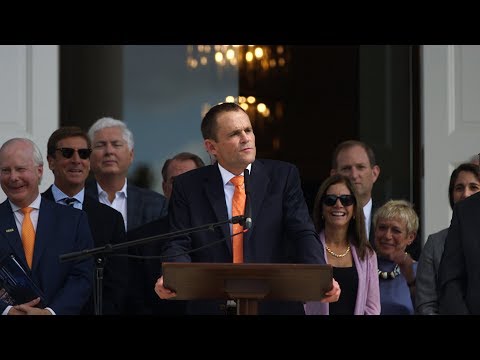
Welcome everyone and good morning on this beautiful day in Charlottesville.
My name is Rusty Connor and I have the special honor of serving as the rector of the University
of Virginia.
Today we celebrate a very special occasion in the life of this great University.
Moments ago the Board of Visitors unanimously elected James Edward Ryan to serve the ninth
president the University of Virginia.
I'm afraid that might go on and on.
What began in earnest at the beginning of the year, to attract an extraordinary leader
as we embark on our third century, has concluded today with the selection of a person we believe
is the perfect leader for this institution at this precise time in its history.
Jim is a distinguished academician, administrator, and legal scholar.
He currently serves as the Dean of the Harvard Graduate School of Education.
A first generation college student, Jim is no stranger to this university.
After attending Yale University for his undergraduate studies and graduating summa cum laude, Jim
enrolled at the UVA School of Law on a full scholarship.
He would graduate first in his class and then go on to clerk for the Chief Judge of the
Ninth Circuit Court of Appeals, and then for United States Chief Justice William H. Rehnquist.
He returned to the UVA School of Law in 1998 to join the faculty where he served as the
academic associate dean and founded and directed the school's program in Law and Public Service.
He proved to be an exceptional teacher, and in 2010 was named the recipient of an All-University
Teaching Award.
And in 2011, he was recipient of an Outstanding Faculty Award from the State Council of Higher
Education in Virginia.
Jim also has a record of public service and volunteerism.
In 2011, the US secretary of education named him to the Department of Education Equity
and Excellence Commission.
He previously served on the board of the Tapestry Project in New York, the Maya Angelou Public
Charter School in Washington, and the Legal Aid Justice Society in Charlottesville.
It is his service and orientation and belief that public universities play a unique role
in elevating all in our society that attracted Jim to us, and I believe us to Jim.
His writing focuses on the intersection of education and law, and he is the author of
the acclaimed Five Miles Away, A World Apart, which examines the modern history of how law
has shaped educational opportunities.
We cannot be happier that as we stand here today, Jim and his family stands with us.
The Ryans will be relocating from Boston to Charlottesville.
And the university and Charlottesville communities look forward to welcoming all of them, including
Katie also a graduate of the UVA School of Law, and their four children.
[APPLAUSE]
So Katie and Jim, welcome home to a place your heart never left.
As rector, I also want to express on behalf of the board and the university our deepest
appreciation to current president Teresa Sullivan.
[APPLAUSE]
Terry has served with great distinction and has been a remarkable ambassador for UVA and
the Commonwealth of Virginia.
She has led the university to greater heights and has advanced every aspect of the university's
mission, from education to research and patient care to public service.
Terry will continue to play a critical role leading us into our bicentennial over the
next several months.
And we very much appreciate her kind offer to help with Jim's transition back to the
grounds.
Terry, thank you for your remarkable contributions to this university.
We will forever be grateful for your leadership, your tireless efforts, and your grace.
[APPLAUSE]
I would also like to note that Bob O'Neil and John Casteen, the sixth and seventh presidents
of the university, are here with us today.
We appreciate them being here today on this special day.
And their presence makes it even that much more special.
I now would like to invite Bill Goodwin, our former rector and co-chair of the presidential
search committee, to offer a few comments.
Bill?
[APPLAUSE]
Well thank you Rusty.
It really is a bright day.
The sun is shining and all is well.
I'll tell you with the announcement of Jim, we are in great shape.
But I do have a few comments I'd like to make.
I particularly would like to acknowledge and thank the committee that I think was 22 of
us that have met monthly or more for the last, I guess, most of this year.
Each of those committee members has really worked hard.
I had great attendance.
And I had stressed confidentiality, so one of the reasons you probably haven't heard
a lot about what was going on is that we weren't going to talk about what was going on.
So I want to thank that committee very much.
I also would like to highlight that, when we started the committee some months ago,
I had sort of suggested to the committee that we were certainly going to be open and interview
anyone who legitimately was desirous of the presidential job, but that I thought in a
final analysis that we ought to be prepared to go recruit who we thought would be the
right person.
And I want to assure you that we did recruit.
It was very, very intense.
Many people helped.
I don't want to name too many names, but John Jeffries and Mimi Riley particularly helped
a lot.
Rusty and I helped some.
And so Jim, you and Katie, I just want to let you know we did recruit you and I'm really
glad we caught you.
So thank you.
Thank you.
[APPLAUSE]
Obviously I don't want to repeat what Rusty has said, but I would have to say from my
point of view as being rector for two years and vice rector for two years prior to that,
which were four of the five years since 2012, Terry is one great woman.
And she has--
[APPLAUSE]
She has worked diligently and hard in caring for this university.
And I know that as we make this transition she will work just as hard to make this as
successful a transition as possible.
I always have said since I've been involved in rector and vice rector, every time I get
in front of a microphone I have to say this, and I have to say it, and I say it with a
lot of enthusiasm.
We have got a great, great university here.
[APPLAUSE]
And we are poised for lots of reasons to go further, faster, and climb even higher mountains.
And I think Jim is the right person to lead us for the next decade or so.
And I'm so, so happy that he's accepted our request.
Thank you.
[APPLAUSE]
So let me present the ninth president of the University of Virginia, James Edward Ryan.
[APPLAUSE]
So thanks Bill and Rusty, and thanks to all of you for coming.
It's a delight to see so many friends in the audience.
And I'm especially pleased that fully 1/3 of the UVA presidency is represented here
in President Sullivan, Casteen, and O'Neil.
So I realize many of you may be wondering about a question I'm asking myself.
What am I doing here?
I'm here first and foremost because, like you, I love UVA.
But I'm also here because I was told that this is where they're handing out free tickets
to the concerts at Scott Stadium.
Is that not true?
In all seriousness I'd like to begin by giving thanks.
First I'd like to thank two presidents.
Thanks to President Sullivan for her tireless leadership of this university.
It will be an honor and a privilege to follow her and to build upon the tremendous progress
she and all of you have accomplished during her tenure.
President Sullivan has been a champion for UVA and has helped this institution not simply
weather stormy seas but to emerge stronger every time.
I'm confident this will also be the case in the aftermath of the deadly, hateful rally
in August.
Like all of you I was heartbroken and horrified to see UVA and Charlottesville invaded by
groups of white supremacists and neo-Nazis.
And I join those who have condemned this violent display of hatred.
But condemning bigotry and anti-Semitism and racism is, in many ways, the easy part.
The hard part, which you're all facing now, is what to do in response, both in the short
and longer terms.
And as an alumnus and former faculty member, I am heartened by the progress so far and
eager to help continue that progress, though I fully recognize that progress, while it's
happening, can seem both messy and a version of two steps forward, one step back.
But it's still progress.
I'd also like to thank Harvard president Drew Faust who took a chance on me four years ago
when she hired a law professor from UVA to be the dean of the Harvard Graduate School
of Education.
It's been a great privilege to lead a school with such a clear and compelling mission.
And President Faust has been a mentor, role model, and true friend.
Without her support I'm quite sure I wouldn't be here today.
I'd also not be here today but for the decision of the search committee.
I'd like to think that committee, especially the co-chairs Rusty Conner and Bill Goodwin,
as well as the board of visitors.
I'm grateful for the trust they've placed in me, and I will work to justify that faith
and to earn your trust.
Although I'm saddened to leave the Harvard Ed School community I've come to love and
admire, I'm honestly thrilled and genuinely honored by the opportunity to serve my Alma
mater and the institution at which I taught for 15 years.
The simple truth is that this is home for me.
This is where my wife Katie and I met when we were law students in the early 1990s.
This is where our four children spent the bulk of their childhoods.
And this is where I developed lifelong friendships, many with people who are still a part of this
community.
I see this very much as an opportunity to serve and to give back to a university and
a community that has given so much to me and my family.
And speaking of my family, I'd like to thank them for joining me on this journey.
When Katie and I told our four kids Will, Sam, Ben, and Phoebe about this opportunity,
they responded perhaps not surprisingly by saying, wait, what?
You as president of UVA?
You have got to be kidding me.
So once they overcame their disbelief, they were incredibly supportive and game to return
to Charlottesville.
And I'm delighted that both Sam and Phoebe could make it today.
To be sure, there may have been some mild bribery involved and vague promises of endless
Bodo's Bagels and tickets to sporting events.
But I nonetheless appreciate their flexibility and sense of adventure.
I'd like to think Katie's parents, Steve and Marcie Homer, and Katie's sister Susan, who
are here today, for supporting Katie and me throughout this process, even though they
knew it meant we would move farther away from them.
I'd also like to thank my sister Claire who is here today and has always been there for
me.
More than anyone else, especially since our parents passed away, Claire reminds me to
stay true to the person my parents raised me to be.
And I'd like to thank my close friend Steve Gillon, also here today, who is not technically
family but has, over the course of more than three decades, become like a brother to me
and an uncle to all of our kids.
And last but not least, I'd like to thank Katie, who recognizes as much as I do that
this is an important moment in the history of higher education and the history of this
university and this community.
Katie is a remarkably talented and dedicated public interest lawyer who works with special
education students and their families.
And she has a heart as large as her talents.
For those of you who don't already know us, you'll soon come to realize that the best
thing about my becoming president is that it means that Katie will again be a part of
the UVA and Charlottesville community.
I will have to pay for not taking those remarks out as promised.
But they're important to say.
So back to I'm here-- I'm here because I believe deeply in the power of education and in the
power and goodness of this remarkable university.
I attended public schools in my hometown of Midland Park, a small, then mostly blue collar
town in Northern New Jersey.
As Rusty described, I was a first generation college student and was able to attend Yale
thanks to generous financial aid and the hard-earned savings of my parents.
And later I attended UVA Law School thanks to a full scholarship.
These opportunities and experiences literally changed my life and opened doors for me that
I never knew even existed when I was a kid.
The basic truth is that the education system worked for me.
It worked the way it's supposed to work.
And I've spent most of my professional life dedicated to ensuring that it works for others.
Indeed working to expand educational opportunities for students has been the guiding principle
and aim of my professional life.
This is why I studied and taught law and education and the different ways that law structures
educational opportunity.
This is why I went to Harvard to become the dean of their education school, and that's
why I am returning here at this point in time.
I know this sounds cliche, but I honestly care most about making a positive difference
in the world.
And I believe in the power of this institution to make the world a better place.
I'm also here because I believe what you choose to do here and in Wise matters, not just to
this community but to higher education generally, to the city of Charlottesville, the Commonwealth
of Virginia, and beyond.
We live in tumultuous times as you know well.
In an era of deep societal divisions, it matters that you are not only committed to a diverse
and inclusive community but that you demonstrate how and why diversity is a source of strength
and vibrancy and need not be a source of division.
It matters that you disagree with each other, but do so with mutual respect and civility.
In an era where there is increased distrust of established institutions, including in
higher education, it matters that you show what a well-functioning and equitable university
looks like and that you demonstrate your value not just to this community but to the wider
world.
In an era where there is too much suffering and stagnation, it matters that you remain
a place of hope and an engine for mobility and progress.
And finally in an era when some would choose the darkness of prejudice, bigotry, and racial
violence, it matters that you are a place of light, indeed a place of thousands of candle
lights that help illuminate the good that resides in all of us.
I'm sure you're curious to know exactly what I hope to do during my time here, which is
understandable.
I do not lack for ideas or opinions, as you will soon come to know for better or for worse.
But it would be foolish and disrespectful to spell out priorities in detail without
first spending more time here and without speaking with students, faculty, staff, board
members, alumni and friends, and getting a sense of your aspirations.
Any vision for moving forward, in order to be compelling and workable, must be a shared
vision.
What I can say is that I will work every day with all of you to help make this university
the very best it can be and to fully live out its core values of academic rigor, accessibility
and commitment to diversity, honor, student self-governance, public service, civility,
and mutual respect.
I believe this is the preeminent public university in this country.
And my goal will be to make this true beyond any doubt.
This means at the very least recruiting a talented and genuinely diverse group of students,
ensuring that this university remains accessible and affordable for all, and that all can flourish
within a culture of trust, respect, and belonging.
That means nurturing and strengthening the distinctive and remarkably vibrant student
experience that features frequent interactions with faculty, high levels of engagement, and
outstanding athletics, music, and art.
It means recruiting and supporting talented and broadly diverse faculty across all disciplines
and in every school and providing them the resources they need to be both outstanding
teachers and researchers.
It means continuing to provide first class health care and supporting basic scientific
and medical research.
And it means being a partner and a good neighbor with Charlottesville and being a real service
to the commonwealth and beyond.
It also means taking some risks and not being afraid of failure.
And it means confronting and understanding this university's past, both the good and
the bad, the distant and the not so distant.
It means acknowledging without apprehension but instead with all due humility both the
brilliance of Thomas Jefferson and the brutality.
It means appreciating that the history of this university is intertwined with the paradoxical
history of this country, including links to our highest and most enduring aspirations
and to our original sin of slavery.
It also means, however, that we not simply understand and learn from our past but that
we also and always keep our eyes on the future, recognizing that it is ours to shape.
Indeed it's crucial to remember that Jefferson himself was literally a revolutionary who
believed in progress above all.
To remain true to Jefferson is in a way to constantly strive to form a more perfect university.
To me what this university looked like in 1850 or even in 1950 is important to understand,
but it's far more important to envision what this university will look like tomorrow or
in 2050.
I'm excited to begin, though I recognize and appreciate that my start date is next fall.
In the meantime you are in strong hands with President Sullivan.
And UVA does not need two presidents.
Indeed it's not lost on me that Thomas Jefferson did not think UVA needed even one president.
And that was true for the first 55 years of this university with no apparent effect on
US News and World Report rankings, which didn't technically exist yet but still.
In any event, like I said, you are in good hands and I have a full time job back in Cambridge
to which I am fully committed until the end of my deanship at the end of this academic
year.
You should expect nothing less than my full and complete commitment when I begin as president,
but until then I would ask for your help in allowing me to honor my current obligations.
Let me end by making two promises I know I can keep.
The first is that when I begin and throughout my time here, I will ask a lot of questions.
Some of them undoubtedly will be annoying, but I promise I will listen carefully to your
answers.
I see my first task as getting reacquainted with parts of the university I knew well before
I left and learning about the parts I didn't know as well, and listening and learning from
all of you here and in Wise.
I have a lot to learn and I look forward to hearing both your concerns and your aspirations
for this university, all in an effort to set a clear and compelling path for the next chapter
in the life of this wonderful place.
The second thing I can promise is that I will make mistakes.
But I will also follow the advice of a basketball coach I had when I was in fifth grade playing
in a Catholic youth league in my hometown.
"It's OK to make mistakes," he said, "and I will tolerate mistakes from exuberance.
I will not tolerate mistakes from lethargy."
Now at the time I knew this sounded important but I had no clue what my basketball coach
was saying because, as a fifth grader, I had no idea what exuberance or lethargy meant.
But once I understood the meaning of those words I came to appreciate the advice of my
coach.
I promise I will make mistakes, and some of them for sure will come from exuberance.
I promise I will never make a mistake from lethargy.
Thank you.
 For more infomation >> Look, you - What is TDR? #14 | Terminator | You will find Annie Mae - Duration: 0:43.
  For more infomation >> Cooking an Egg on the Grou...
 For more infomation >> Uomini e Donne, la Galgani ei suoi pensieri mattutini | K.N.B.T - Duration: 2:49.
  For more infomation >> Peugeot 308 1.6 E-HDI BLUE LEASE EXECUTIVE "AUTOMAAT" ECC/NAVI/LMV/MIST.LAMP - Duration: 1:01.
  For more infomation >> Gossip e Tv: Maria De Filippi rivoluziona 'Amici', ecco chi va e chi resta - Duration: 4:29.
  For more infomation >> Prévia da Fundição Volskaya - Heroes of the Storm - Duration: 4:46.
  For more infomation >> Love On Top - As picardias entre Paulo e Kika estão de volta - 14 de Setembro de 2017 - Duration: 4:54.
  For more infomation >> FINESTRINO O CORRIDOIO? ✈ TU DOVE TI SIEDI? - Duration: 2:16.


 For more infomation >> Bozo ou Bingo, da TV dos anos 1980 para o Oscar 2018 - Duration: 3:27.
 For more infomation >> 👑👑 [Afro-House] - Dotorado Pro - Sweet Afrika - Duration: 3:24.

 For more infomation >> Huracán Irma: el dolor de los productores agrícolas latinos de la Florida | Noticias | Telemundo - Duration: 3:00.
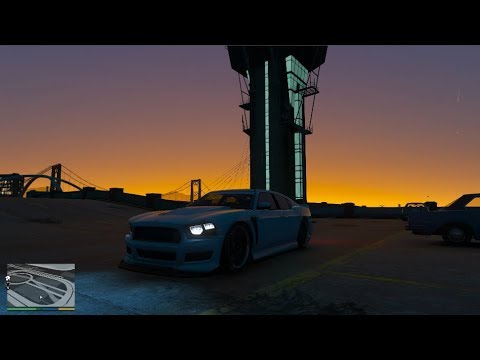 For more infomation >> The Most Realistic Mod of GTA V Remastered | Natural Vision Remastered - Duration: 4:07.
  For more infomation >> Las Noticias de la mañana, viernes 15 de septiembre de 2017 | Noticiero | Noticias Telemundo - Duration: 4:40.
  For more infomation >> Volkswagen Passat Variant €2.734,- voordeel 1.4 TSI 125pk Highline Business R (vsb 13868) Rijklaar - Duration: 0:57.
  For more infomation >> Renault Clio 1.5 dCi Limited (R-LINK/Climate/PDC/LMV) - Duration: 0:47.
  For more infomation >> Renault Captur TCE 90pk Dynamique (CAMERA/R-link/Climate/Cruise/PDC/17''LMV) - Duration: 0:51.


 For more infomation >> I DON'T HAVE ISPIRATION (ITA SUB) - Duration: 2:05.
  For more infomation >> Fiat 500C ABARTH 1.4 T-JET 140 PK AUT AKRAPOVIC - Duration: 0:58.
  For more infomation >> 10 Practical Camera Hacks FAST - Duration: 2:19.





No comments:
Post a Comment